
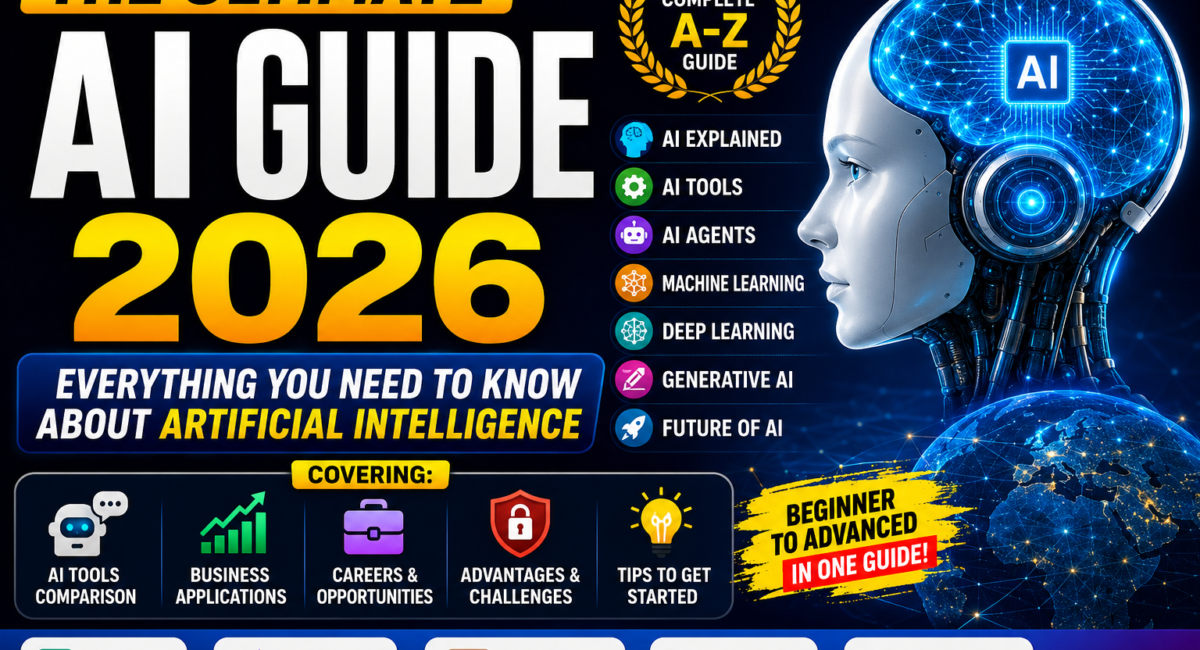
The Ultimate AI Guide: Everything You Need to Know About Artificial Intelligence
- What is Artificial Intelligence
- The Birth of AI (1950–1956)
- arly AI Research (1960s–1970s)
- The AI Winter (1970s–1980s)
- Expert Systems Era (1980s)
- Machine Learning Revolution (1990s–2010)
- Deep Learning Breakthrough (2012–2020)
- Generative AI Era (2022–Present)
- 1. Narrow AI (Weak AI)
- 2. General AI (Strong AI)
- 3. Super Artificial Intelligence
- Types of Machine Learning
- Key Differences
The Ultimate AI Guide : Everything You Need to Know About Artificial Intelligence Step By Step Read
Artificial Intelligence AI has become one is of the most transformative technologies of the modern era, From Mobiles and search engines to health care, finance, education and business automation, AI is reshaping the way people work, communicate and solve problems, What once existed only in science fiction is now an essential part of every day life, helping individuals and organizations complete complex tasks a more efficiently
Today millions of people use AI powered tools without even realizing it, Voice assistants answer questions recommendation systems suggest movies and products, navigation apps calculate the fastest routes and AI chatbots provide instant customer support, Businesses use AI to automate repetitive work, analyze large amounts of a data, improve customer experiences and make smarter decisions
In recent years the rapid growth of a generative AI and intelligent AI agents has made Artificial Intelligence more the accessible than ever before, Tools such as ChatGPT, Google Gemini, Claude AI and Microsoft Copilot are helping students, developers, marketers, writers, researchers and business owners increase productivity while reducing manual effort
However Artificial Intelligence is a much more than just chatbots, It includes machine learning, deep learning, computer vision, natural language processing, robotics and predictive analytics, These technologies work together to a enable computers to understand information, recognize patterns, learn from experience and perform tasks that traditionally required human intelligence
What is Artificial Intelligence
Artificial Intelligence refers to the computer systems that are designed to perform tasks that normally require human intelligence, These tasks include learning from data, understanding language, recognizing images, solving problems, making decisions and generating new content
Unlike traditional software that follows fixed instructions AI systems can improve their performance by the identifying patterns in data and adapting their responses over time, This ability allows AI to solve increasingly complex problems across a wide range of industries
ai is built using advanced algorithms large datasets and powerful computing systems, Modern AI combines technologies such is a machine learning, deep learning, natural language processing and computer vision to for create intelligent applications capable of interacting with humans and automating complex processes
Today AI is widely used in :
- Healthcare
- Banking and Finance
- Education
- Agriculture
- Manufacturing
- Transportation
- E commerce
- Cybersecurity
- Digital Marketing
- Software Development
As AI continues to evolve it is expected to the become even more integrated into everyday life, enabling smarter devices, more efficient businesses and innovative solutions to global challenges
| Industry | How AI is Used | Popular AI Technologies | Main Benefits | Future Growth |
|---|---|---|---|---|
| Healthcare | Disease prediction, medical imaging, patient monitoring, virtual assistants, drug discovery. | Machine Learning, Computer Vision, NLP | Improves diagnosis accuracy, faster treatment planning, better patient care. | Very High |
| Education | Personalized learning, AI tutors, automatic grading, lesson planning. | Generative AI, NLP | Better student engagement and personalized education. | Very High |
| Finance | Fraud detection, investment analysis, customer support, credit scoring. | Machine Learning, Predictive Analytics | Enhanced security and smarter financial decisions. | High |
| E-Commerce | Product recommendations, chatbot support, dynamic pricing. | Recommendation Engines, NLP | Higher sales and improved customer experience. | Very High |
| Manufacturing | Quality inspection, predictive maintenance, robotics automation. | Computer Vision, Deep Learning | Reduced downtime and improved production quality. | High |
| Agriculture | Crop monitoring, pest detection, weather forecasting, smart irrigation. | Computer Vision, IoT + AI | Higher crop yields and efficient resource management. | Growing |
| Marketing | Content creation, customer segmentation, campaign optimization. | Generative AI, Predictive Analytics | Higher ROI and better customer targeting. | Very High |
| Cybersecurity | Threat detection, malware analysis, anomaly detection. | Machine Learning, Deep Learning | Faster identification of cyber attacks. | Very High |
| Transportation | Route optimization, autonomous driving assistance, fleet management. | Computer Vision, Reinforcement Learning | Reduced fuel costs and safer transportation. | High |
| Media & Entertainment | AI video editing, script writing assistance, image generation, recommendation systems. | Generative AI, Deep Learning | Faster content creation and personalized recommendations. | Explosive |
History of Artificial Intelligence
Artificial Intelligence has a fascinating history that spans a more than seven decades, Although the concept of intelligent machines appeared in science fiction long before computers became common the modern field of a AI officially began in the 1950year Since then, Artificial Intelligence has evolved through periods of rapid innovation, limited progress, renewed investment and remarkable break throughs that continue to shape today technology landscape
The earliest ideas behind AI were inspired by a simple question: Can machines think like humans Researchers believed that if computers could process information logically, they might eventually solve problems, learn from experience and make intelligent decisions
The Birth of AI (1950–1956)
The foundations of the Artificial Intelligence were established by mathematicians and computer scientists who explored whether machines could imitate human thinking, During this period, researchers focused on logic, reasoning and problem solving rather than large scale learning from data
In 1956 the term Artificial Intelligence was officially introduced during the a Dartmouth Summer Research Project, which is widely regarded as the birth of AI as an academic discipline, Researchers believed that intelligent machines could eventually perform tasks such as language understanding, reasoning and self improvement, Ancient History Check now
arly AI Research (1960s–1970s)
Following the Dartmouth conference, universities and research laboratories invested heavily in AI research, Scientists developed programs capable of solving mathematical problems, playing simple games and proving logical theorems
Although these early systems demonstrated promising results, they struggled outside carefully controlled environments because computing power and available data were limited
The AI Winter (1970s–1980s)
As expectations grew progress slowed, Many ambitious predictions failed to the become reality, resulting in reduced funding and declining public interest, This period became known as the AI Winter
During these years researchers realized that creating truly intelligent systems was far more difficult than originally expected
Expert Systems Era (1980s)
Interest in AI returned with the development of the Expert Systems, These programs were designed to a mimic the decision making abilities of human specialists in specific domains such as medicine, finance and engineering.
Expert systems became popular because they helped businesses automate specialized tasks, although they still relied on manually created rules rather than learning from data
Machine Learning Revolution (1990s–2010)
As computers became more powerful and digital data increased, researchers shifted toward Machine Learning Instead of programming every rule manually, computers learned patterns directly from data
Machine Learning significantly improved :
- Image recognition
- Speech recognition
- Recommendation systems
- Fraud detection
- Search engines
Deep Learning Breakthrough (2012–2020)
Deep Learning transformed Artificial Intelligence by the allowing computers to process enormous datasets using neural networks with many layers.
Major improvements included :
- Face Recognition
- Self driving vehicle research
- Medical image analysis
- Voice assistants
- Language translation
Deep Learning dramatically increased AI accuracy compared to traditional machine learning methods
Generative AI Era (2022–Present)
The introduction of a powerful Large Language Models (LLMs) made Artificial Intelligence accessible to millions of users worldwide
Modern AI systems can now :
- Write articles
- Generate images
- Create videos
- Write computer code
- Analyze documents
- Translate languages
- Summarize research papers
- Assist businesses with automation
This period represents one of the fastest technological transformations in a modern history
| Year | Major Milestone | Impact |
|---|---|---|
| 1950 | Early AI Concepts | Foundation of intelligent computing |
| 1956 | Dartmouth Conference | Artificial Intelligence officially named |
| 1970s | AI Winter | Reduced funding and slower progress |
| 1980s | Expert Systems | Business automation expanded |
| 1990s | Machine Learning | Data-driven intelligence emerged |
| 2012 | Deep Learning | Major improvement in AI accuracy |
| 2022 | Generative AI | AI became widely accessible |
| 2026 | AI Agents | Autonomous workflow automation grows |
How Artificial Intelligence Works
Artificial Intelligence works by combining data algorithms, computing power and continuous learning, Instead of the following only fixed rules, AI systems analyze large amounts of information to a identify patterns and improve their predictions over time
A simplified AI workflow looks like this :
- Data Collection : Gather text, images, audio, video, or numerical information
- Data Processing : Clean and organize the data for training
- Model Training : Use algorithms to learn patterns from the data
- Prediction or Decision : Apply the learned patterns to new inputs
- Feedback & Improvement : Refine the model as more data becomes available
For example an email spam filter learns from thousands of the spam and non spam messages. Over time it becomes better at recognizing unwanted emails without needing every rule to be manually programmed
| Component | Purpose |
|---|---|
| Data | The information used for learning |
| Algorithms | Mathematical methods that identify patterns |
| Model | The trained AI system |
| Training | Teaching the model using data |
| Inference | Using the trained model to make predictions |
| Feedback | Improving performance over time |
Types of Artificial Intelligence
Ai can be classified in several ways based on its capabilities and functionality, Understanding these types helps explain how modern AI systems are designed and what they can achieve
Currently, most AI systems available today belong to the Narrow AI category, which means they are built to a perform specific tasks, Researchers continue working toward more advanced forms of AI that may eventually perform a wide range of human level activities
1. Narrow AI (Weak AI)
Narrow AI is designed to perform one specific task extremely well It cannot think independently outside its assigned function
Examples include :
- ChatGPT
- Google Gemini
- Siri
- Alexa
- Netflix Recommendations
- Google Maps Navigation
- Spam Email Detection
Although Narrow AI appears intelligent it cannot perform unrelated tasks without additional programming
2. General AI (Strong AI)
General AI refers to machines capable of performing any intellectual task that humans can perform.
A true General AI system would :
- Learn independently
- Solve unfamiliar problems
- Understand emotions
- Make decisions
- Adapt to new environments
Currently General AI remains a research goal and has not yet been achieved
3. Super Artificial Intelligence
Super AI represents a theoretical stage where machines surpass human intelligence in the every field
Potential capabilities include :
- Scientific discoveries
- Medical research
- Engineering
- Creative writing
- Decision making
- Autonomous innovation
Super AI does not currently exist but is widely discussed in future AI research
| AI Type | Current Status | Examples |
|---|---|---|
| Narrow AI | Available Today | ChatGPT, Siri, Gemini |
| General AI | Under Research | Not Yet Available |
| Super AI | Theoretical | Future Concept |
Machine Learning Explained
Machine Learning (ML) is a one of the most important branches of Artificial Intelligence
Instead of programming every rule manually, Machine Learning enables computers to the learn patterns from data and improve automatically with experience
For example if thousands of images of cats and dogs are provided to a machine learning model, it gradually learns the visual differences between them Eventually, it can identify new images without being explicitly programmed.
Machine Learning powers many everyday applications including :
- Google Search
- YouTube Recommendations
- Netflix Suggestions
- Fraud Detection
- Online Shopping Recommendations
- Credit Card Security
- Voice Recognition
Types of Machine Learning
Supervised Learning
The model learns using labeled data
Example :
- House Price Prediction
- Disease Diagnosis
- Email Spam Detection
Unsupervised Learning
The model identifies hidden patterns without labeled data
Examples :
- Customer Segmentation
- Product Recommendations
- Market Analysis
Reinforcement Learning
The AI learns by receiving rewards or a penalties after taking actions.
Examples :
- Robotics
- Game Playing
- Self driving Car Research
| Learning Type | Uses Labels | Example |
|---|---|---|
| Supervised | Yes | Price Prediction |
| Unsupervised | No | Customer Clustering |
| Reinforcement | Reward System | Robotics |
Deep Learning Explained
Deep Learning is an advanced form of the Machine Learning that uses large neural networks to process massive amounts of data
Unlike traditional Machine Learning, Deep Learning automatically discovers important features without requiring manual programming.
Deep Learning has dramatically improved AI performance in :
- Image Recognition
- Speech Recognition
- Language Translation
- Medical Imaging
- Self driving Technology
- Chatbots
- AI Image Generation
- AI Video Creation
Because Deep Learning requires large datasets and powerful GPU it has become practical only in recent years
Neural Networks
Neural Networks are computer models inspired by the human brain.
They consist of interconnected layers of artificial neurons that process information
A basic neural network contains :
- Input Layer
- Hidden Layers
- Output Layer
As data moves through these layers, the network learns increasingly complex patterns
Neural Networks power modern AI applications such as :
- Face Recognition
- Speech Recognition
- AI Writing
- AI Coding
- AI Translation
- Medical Diagnosis
Artificial Intelligence vs Machine Learning vs Deep Learning
| Feature | Artificial Intelligence | Machine Learning | Deep Learning |
|---|---|---|---|
| Definition | Broad field of intelligent systems | Subset of AI | Subset of Machine Learning |
| Requires Data | Sometimes | Yes | Yes |
| Learns Automatically | Limited | Yes | Yes |
| Uses Neural Networks | Optional | Sometimes | Always |
| Complexity | Medium | High | Very High |
| Examples | ChatGPT, Siri | Recommendation Systems | Image Recognition |
Key Differences
| AI | Machine Learning | Deep Learning |
|---|---|---|
| Broad Technology | Learning Algorithms | Advanced Neural Networks |
| Human Rules Possible | Mostly Data Driven | Fully Data Driven |
| Faster Training | Moderate | Slower |
| Less Computing | Moderate | Very High GPU Required |
Why Machine Learning Matters
Machine Learning is transforming almost a every industry because it allows businesses to make faster and smarter decisions using data
Organizations use Machine Learning to :
- Predict customer behavior
- Detect fraud
- Improve healthcare diagnosis
- Optimize logistics
- Personalize recommendations
- Automate repetitive tasks
- Improve cybersecurity
As data continues to grow Machine Learning will become even more valuable across business, education, health care, finance, agriculture, and scientific research
What is Generative AI?
Generative AI is 1 of the most exciting developments in Artificial Intelligence, Unlike traditional AI systems that mainly analyze data or make predictions, Generative AI can create entirely new content based on user instructions
It can generate :
- Articles
- Images
- Videos
- Computer Code
- Music
- Presentations
- Emails
- Marketing Content
Generative AI works using advanced machine learning models trained on massive datasets, These models learn patterns in language, images and other forms of data, allowing them to produce realistic and useful outputs
Today, millions of people use Generative AI to improve productivity save time and automate creative work
Popular Uses of Generative AI
Businesses and individuals use Generative AI in many different ways :
- Writing blog posts
- Creating marketing campaigns
- Designing logos
- Building presentations
- Writing software code
- Generating product descriptions
- Translating languages
- Creating educational materials
- Summarizing documents
- Brainstorming new ideas
Because of its flexibility, Generative AI has become an essential tool for a professionals across multiple industries
How AI Agents Work
Most AI Agents follow a structured workflow :
- Understand the objective
- Break the task into smaller actions
- Search for relevant information
- Analyze the collected data
- Generate the final result
- Improve future performance based on feedback
This ability makes AI Agents useful for business automation and complex workflows
Benefits of AI Agents
Businesses are adopting AI Agents because they help :
- Save valuable time
- Reduce repetitive work
- Increase productivity
- Improve customer support
- Generate reports automatically
- Schedule meetings
- Manage workflows
- Analyze business data
- Assist software developers
- Support marketing campaigns
ChatGPT Explained
ChatGPT is one of the world most popular AI assistants, It is designed to understand natural language and generate human like responses
People use ChatGPT for :
- Writing articles
- Programming assistance
- Learning new skills
- Brainstorming ideas
- Business planning
- Translation
- Education
- Research
- Customer support
- Content creation
Its conversational interface makes AI accessible even to a beginners
Google Gemini
Google Gemini is Google family of AI models designed to work across text, images, code and other types of information, Gemini integrates with several Google products, making it useful for productivity tasks.
Common use cases include :
- Drafting emails
- Summarizing documents
- Creating presentations
- Writing code
- Research assistance
- Data analysis
- Educational support
Claude AI
Claude AI is known for handling a long documents and producing thoughtful, structured responses
Many professionals use Claude AI for :
- Research
- Document analysis
- Business reports
- Legal document summaries
- Academic writing
- Long form content
Microsoft Copilot
Microsoft Copilot integrates AI into Microsoft 365 applications
It helps users work faster inside :
- Word
- Excel
- PowerPoint
- Outlook
- Teams
Copilot can a generate presentations, summarize meetings, analyze spreadsheets, and draft professional emails
Perplexity AI
Perplexity AI focuses on AI powered search and research, Unlike many traditional search engines it provides summarized answers together with references, making it useful for learning and a information gathering
Common uses include :
- Research
- Academic work
- Fact checking
- Technical documentation
- Industry analysis
| AI Tool | Best For | Free Plan | Ideal Users |
|---|---|---|---|
| ChatGPT | Writing & Coding | Yes | Students, Writers, Developers |
| Google Gemini | Productivity | Yes | Google Workspace Users |
| Claude AI | Long Documents | Yes | Researchers, Professionals |
| Microsoft Copilot | Office Work | Limited | Businesses |
| Perplexity AI | Research | Yes | Students & Researchers |
| Canva AI | Design | Yes | Designers & Marketers |
| GitHub Copilot | Programming | Paid | Developers |
| Midjourney | AI Images | Paid | Designers & Creators |
Which AI Tool Should You Choose?
The best AI tool depends on your goals :
- Students: ChatGPT, Gemini
- Bloggers: ChatGPT, Claude AI
- Researchers: Perplexity AI, Claude AI
- Businesses: Microsoft Copilot, Gemini
- Developers: GitHub Copilot, ChatGPT
- Designers: Canva AI, Midjourney
Instead of relying on a the single platform many professionals combine multiple AI tools to improve productivity
AI in Health care
Artificial Intelligence is transforming healthcare by helping doctors, hospitals and researchers improve patient care while reducing administrative workload, AI powered systems can analyze medical images, identify patterns in patient data and support health care professionals in the making informed decisions
Common applications include :
- Medical image analysis
- Disease prediction
- Virtual health assistants
- Appointment scheduling
- Drug discovery
- Patient record management
- Remote health monitoring
AI assists health care professionals but does not replace medical expertise, Final diagnosis and treatment decisions remain the a responsibility of qualified health care providers
AI in Education
Educational institutions are a increasingly using AI to provide personalized learning experiences
Students benefit from :
- Intelligent tutoring systems
- Language translation
- AI study assistants
- Quiz generation
- Assignment summaries
- Personalized learning recommendations
Teachers use AI to prepare lesson plans, create learning materials and automate routine administrative tasks
AI in Business
Businesses of every size are using Artificial Intelligence to a improve efficiency and customer satisfaction
Popular business applications include :
- Customer support chatbots
- Marketing automation
- Sales forecasting
- Inventory management
- Financial reporting
- HR recruitment assistance
- Business analytics
- Document processing
AI helps organizations save the time while allowing employees to focus on higher value work
AI in Finance
Banks and financial institutions use AI to improve security, detect fraud and enhance customer services
Examples include :
- Fraud detection
- Credit scoring
- Investment analysis
- Risk management
- Automated customer support
- Expense categorization
These systems analyze large volumes of the financial data to identify unusual patterns and support decision making
AI in Agriculture
Artificial Intelligence is helping farmers increase productivity and optimize resource usage
Common agricultural applications include :
- Crop health monitoring
- Smart irrigation
- Weather analysis
- Pest detection
- Yield prediction
- Farm automation
These technologies support more efficient farming practices and the better resource management
AI Career Opportunities
| AI Tool | Primary Purpose | Best For | Free Version | Difficulty | Supported Platforms | Popular Industries | Key Features |
|---|---|---|---|---|---|---|---|
| ChatGPT | AI Writing & Conversation | Students, Bloggers, Developers | YES | Easy | Web, Android, iPhone | Education, Business, Marketing | Writing, Coding, Brainstorming, Translation, Research |
| Google Gemini | Productivity AI | Google Workspace Users | YES | Easy | Web, Android | Business, Education | Docs, Gmail, Sheets, Search, Coding |
| Claude AI | Long Document Analysis | Researchers & Professionals | YES | Easy | Web | Legal, Research, Business | Long Context, Reports, Summaries |
| Microsoft Copilot | Office Productivity | Corporate Employees | LIMITED | Easy | Windows, Office 365 | Corporate, Enterprise | Excel Analysis, Word, PowerPoint, Outlook |
| Perplexity AI | AI Search Engine | Researchers | YES | Easy | Web, Mobile | Research, Education | Real time Search, Citations, Research |
| GitHub Copilot | Programming Assistant | Software Developers | PAID | Medium | VS Code, JetBrains | Software Development | Code Generation, Debugging, Auto Completion |
| Canva AI | Graphic Design | Designers & Marketers | LIMITED | Easy | Web, Mobile | Marketing, Social Media | Logo Design, Posters, Presentations |
| Midjourney | AI Image Generation | Creative Professionals | PAID | Medium | Discord | Design, Advertising | Photorealistic AI Images |
| Runway ML | AI Video Creation | YouTubers & Editors | LIMITED | Medium | Web | Media, Video Production | Text to Video, Video Editing |
| Notion AI | Productivity | Teams & Businesses | LIMITED | Easy | Web, Desktop | Project Management | Meeting Notes, Writing, Documentation |
The rapid growth of a AI has created demand for a professionals across many industries
Popular career paths include :
- AI Engineer
- Machine Learning Engineer
- Data Scientist
- Prompt Engineer
- AI Product Manager
- AI Researcher
- Robotics Engineer
- Computer Vision Engineer
- NLP Engineer
- AI Consultant
Even non technical roles such as marketing, education, content creation and customer support increasingly benefit from AI skills
| AI Skill | Description | Difficulty | Best For | Career Opportunities | Average Learning Time |
|---|---|---|---|---|---|
| Prompt Engineering | Writing effective prompts to get high quality responses from AI tools. | Beginner | Everyone | Content Creator, Freelancer, AI Consultant | 1–2 Weeks |
| Machine Learning | Teaching computers to recognize patterns and make predictions using data. | Advanced | Developers | ML Engineer, Data Scientist | 4–8 Months |
| Deep Learning | Using neural networks for image recognition, speech processing, and AI automation. | Advanced | AI Engineers | Deep Learning Engineer | 6–12 Months |
| Natural Language Processing (NLP) | Helping computers understand, analyze, and generate human language. | Intermediate | Developers | NLP Engineer, AI Researcher | 3–6 Months |
| Computer Vision | Training AI systems to identify and analyze images and videos. | Advanced | AI Professionals | Computer Vision Engineer | 6–10 Months |
| AI Automation | Automating repetitive business workflows using AI powered tools. | Beginner | Business Owners | Automation Specialist | 2–4 Weeks |
| Generative AI | Creating text, images, videos, presentations, and code using AI. | Beginner | Students, Bloggers, Marketers | AI Content Creator | 1–3 Weeks |
| AI Ethics | Understanding responsible AI usage, privacy, fairness, and transparency. | Intermediate | All AI Professionals | AI Policy Advisor | 2–4 Weeks |
| Data Analytics | Collecting, cleaning, and analyzing data for AI based decision making. | Intermediate | Business Analysts | Data Analyst | 2–5 Months |
| AI Agent Development | Building autonomous AI systems that can complete multi step tasks. | Advanced | Developers | AI Agent Developer | 4–8 Months |
Advantages of Artificial Intelligence
Artificial Intelligence offers numerous benefits when used responsibly
- Automates repetitive tasks
- Improves productivity
- Supports faster data analysis
- Assists decision making
- Enhances customer service
- Operates continuously without fatigue
- Reduces manual errors
- Improves accessibility through translation and speech technologies
- Supports scientific research
- Encourages innovation across industries
Challenges and Limitations of AI
Despite its advantages AI also presents challenges
- High implementation costs
- Data privacy concerns
- Potential bias in training data
- Dependence on high quality datasets
- Significant computing requirements
- Need for human oversight in critical decisions
- Workforce changes requiring new skills
- Ethical and regulatory considerations
Responsible development and use of AI are essential to maximize benefits while minimizing risks
Future of Artificial Intelligence
Artificial Intelligence is expected to become even more integrated into everyday life over the coming years
Future developments may include :
- More capable AI assistants
- Improved health care support
- Smarter business automation
- Enhanced educational tools
- Better scientific research assistance
- Increased robotics applications
- Stronger collaboration between humans and AI systems
Rather than replacing people entirely AI is likely to become a the powerful tool that helps individuals and organizations work more efficiently
| Feature | Artificial Intelligence (AI) | Machine Learning (ML) | Deep Learning (DL) | Generative AI |
|---|---|---|---|---|
| Definition | The broad field of creating intelligent computer systems capable of performing tasks that normally require human intelligence | A subset of AI that enables systems to learn patterns from data without explicit programming | An advanced subset of Machine Learning that uses deep neural networks to process complex data | A category of AI focused on generating new content such as text, images, videos, music and code |
| Primary Goal | Replicate human intelligence | Learn from data and improve predictions | Solve highly complex recognition and prediction tasks | Create original content based on user instructions |
| Requires Large Data | Sometimes | Yes | Very Large Datasets | Extremely Large Training Data |
| Uses Neural Networks | Optional | Sometimes | Always | Large Deep Neural Networks |
| Learning Method | Rules + Learning Algorithms | Statistical Learning | Multi layer Neural Networks | Foundation Models & Large Language Models |
| Examples | Virtual Assistants, Robotics | Spam Detection, Recommendations | Image Recognition, Speech Recognition | ChatGPT, AI Image Generation, AI Video Creation |
| Common Industries | Healthcare, Finance, Education, Manufacturing | Marketing, Banking, Retail | Healthcare, Autonomous Vehicles, Security | Content Creation, Software Development, Marketing |
| Difficulty Level | Medium | Advanced | Very Advanced | Beginner Friendly for End Users |
| Business Impact | High | Very High | Extremely High | Revolutionizing Productivity |
| Future Potential | Excellent | Excellent | Excellent | Transformational Across Every Industry |
Frequently Asked Questions (FAQs)
1. What is Artificial Intelligence
Artificial Intelligence is technology that enables computer systems to perform tasks that typically require human intelligence, such as learning, reasoning and language understanding
2. Is AI the same as Machine Learning
No, Machine Learning is a branch of AI that enables systems to learn from data
3. Can AI replace humans
AI can automate certain tasks, but human judgment, creativity and responsibility remain essential in many fields
4. Which AI tool is best for beginners
Many beginners start with conversational AI assistants because they are easy to use and support a the wide range of tasks
5. Is AI free
Many AI services offer free plans, while advanced features are often available through paid subscriptions
6. What industries use AI
Healthcare, education, finance, agriculture, manufacturing, retail, transportation, software development and many others
7. Can students benefit from AI
Yes, AI can help with studying, summarizing information, language learning, coding practice and research
8. What are AI Agents
AI Agents are systems designed to a plan and complete multi step tasks using available tools and information
9. Is AI safe
AI can be safe when developed and used responsibly with appropriate privacy, security and human oversight
10. Why should I learn AI
AI skills are increasingly valuable across many careers and industries, making them useful for both professionals and students

1 Comment